Why is AC repair so expensive?
Parts and licensed labor are the easy answer, and every other page you will find gives you that same list. The real answer is the one nobody explains: an air conditioner is a chain of safety steps, and each one has to prove itself before the next one is allowed to run. So a failure can hide behind another failure. You pay for the first repair, and only then does the system run far enough to show you what else is wrong.
That is not a sales tactic. It is how the equipment is built, and it is built that way on purpose. Here is exactly what it looked like on a real call.
Why did one AC repair turn into three?
July 3rd of this year. No cooling call, southern New Hampshire, hot afternoon. The kind of day the phone does not stop.
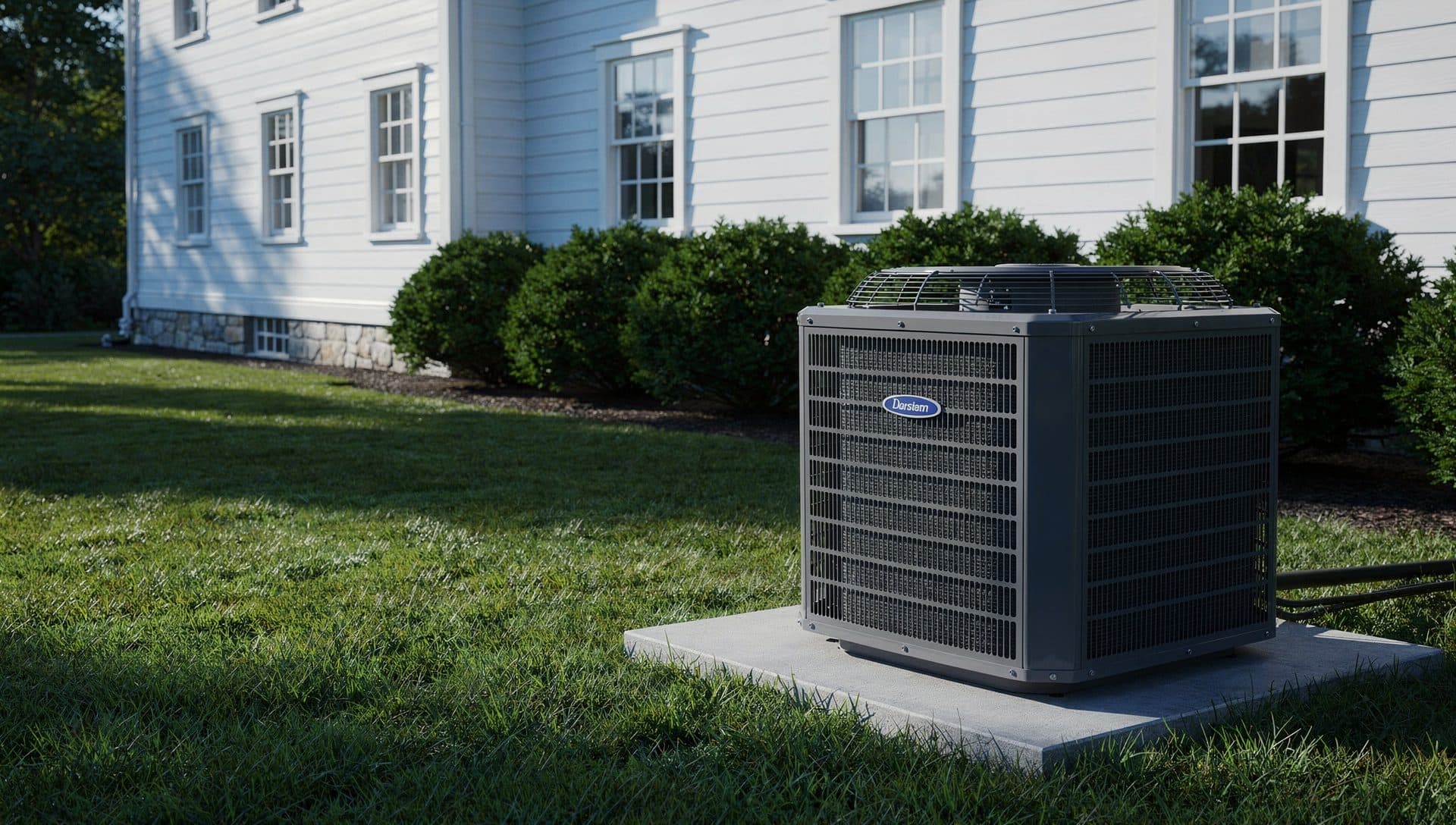
First thing I do is turn the thermostat on and make sure it is actually calling for cooling. Worth knowing: a thermostat lights up on its own batteries whether or not it is sending the signal, so a screen that looks alive tells you nothing. I tested for 24 volts at the furnace, common to Y, which is the cooling call. I had it. Went outside and tested at the condenser. Had it there too.
So the call was reaching the unit and the unit was doing nothing. The contactor was not pulling in. The fan was not turning and the compressor was not running.
That points at the capacitor. Think of it as the jolt that gets the fan motor and the compressor moving. This one was a 45/5, which means one section for the compressor and one for the fan. I put a meter on it and read zero and zero. Both sections dead. That is normally a quick, cheap fix, and if the story ended there it would have been a good day for the homeowner.
New capacitor in. Fan kicks on. Compressor starts turning. And it made a noise I did not like.
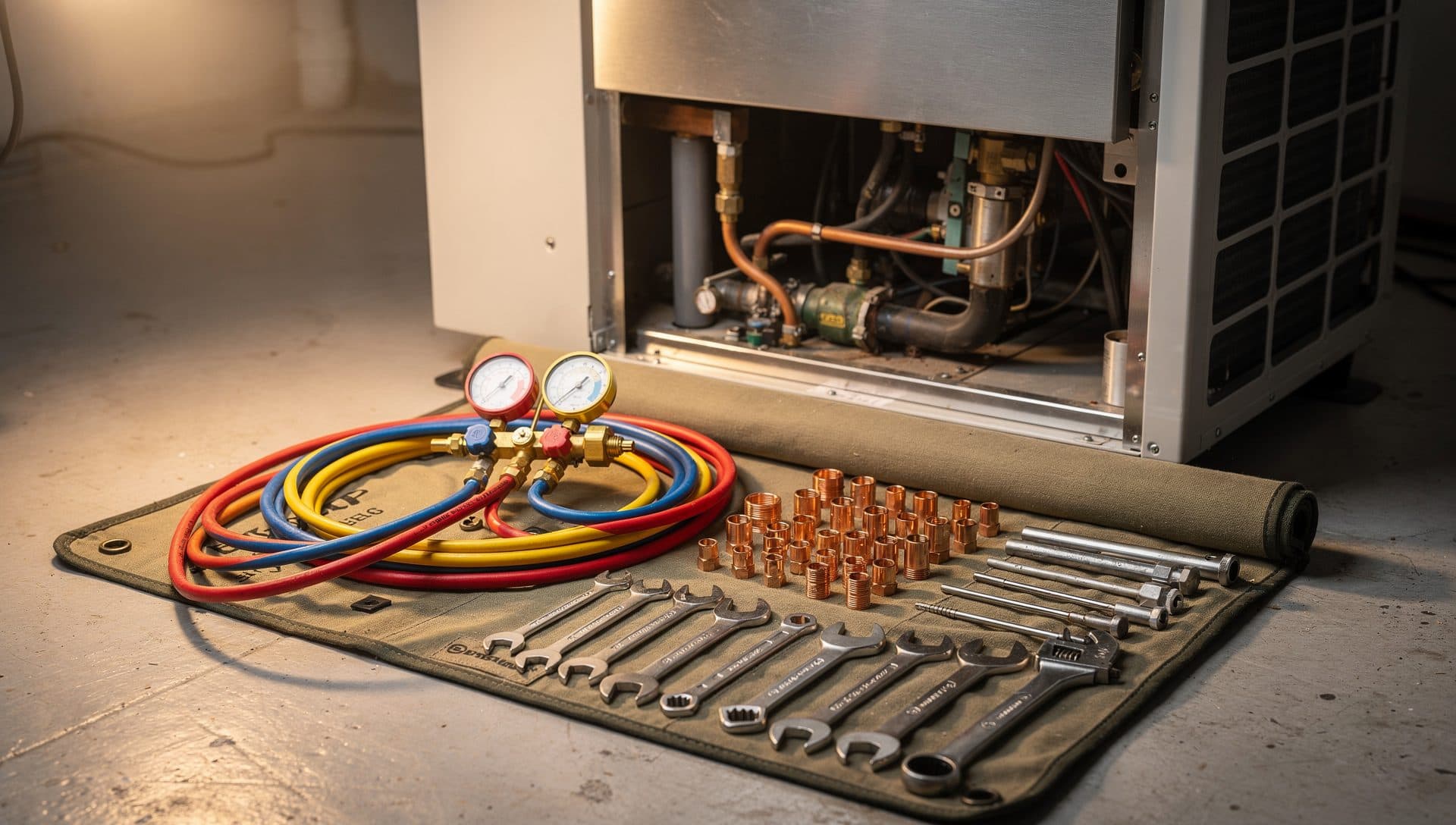
So I hooked up my gauges. Zero PSI. The system was empty. There was no refrigerant in it at all.
I put nitrogen in it to pressurize and hunt the leak. It was a big one, at the high pressure switch. I brazed it up, pressure tested with nitrogen again, held, pulled a vacuum, and charged the system back to the factory spec. The line set was right around 15 feet, so the charge was straightforward.
Fan turning, compressor running. And the pressures were way off. The high side climbed toward 600 and the low side sat down around 40. The unit locked itself out on the high pressure switch, which is exactly what it is designed to do.
Something was restricting the liquid line. Refrigerant was going out and nothing was coming back.
Here is where I want to be precise, because this part gets taught wrong all the time. High head pressure by itself does not prove a restriction. On plenty of restricted systems the head pressure actually runs low, because refrigerant never reaches the evaporator and there is very little heat for the condenser to reject. John Tomczyk, an HVACR professor emeritus at Ferris State University, said it flatly in the ACHR News in March 2020: many technicians believe that if any part of the high side is restricted, head pressure will elevate, and that is simply not the case. The real tell for a restriction is subcooling, not head pressure.
What I had in front of me was the other version of it. A residential split system has no receiver, so with a full factory charge and a restriction downstream, the liquid stacks up in the condenser with nowhere to go and the head pressure climbs until the safety opens. That matches what my gauges were telling me, and it is why the unit would not stay running.
On a TXV system a liquid line restriction means the metering valve or the filter drier. I recovered the refrigerant I had just put in, which is money I do not get back and which the law requires anyway, because venting it is illegal under Section 608 of the Clean Air Act. Then I cut out the drier, replaced the TXV, pressure tested, vacuumed, and charged it one more time.
Then it ran. Right pressures, cold air, quiet.
| What I found | How it showed up | Why it could not be found sooner |
|---|---|---|
| Dead 45/5 dual run capacitor | Fan and compressor both silent, contactor not pulling in | Nothing downstream can be watched on a unit that will not start |
| Major refrigerant leak at the high pressure switch | Zero PSI on the gauges once the unit finally ran | An empty system holds no pressure to leak test until nitrogen goes in |
| Liquid line restriction at the TXV and filter drier | High side climbing toward 600, low side at 40, locking out on the safety | A restriction only shows itself once the system is sealed, charged, and running |
Three real failures, one visit. I told the homeowner the same thing I will tell you: that is rare. Usually the capacitor is bad, you swap it, the unit runs, and you are done. Or there is a leak, you find it and fix it, and the unit runs. Getting all three stacked on one machine is a bad luck day, and I have not seen it line up like that in a long time.
Why couldn't the technician find everything at once?
This is the part worth understanding, because it is the reason an honest bill grows.
Every HVAC system runs a fixed sequence of operations. That is the trade term for it, and every system has its own: a gas furnace, a conventional split system, a heat pump, a ductless mini split. Each step has to prove itself before the equipment allows the next one to happen. The alternative is unsafe, so the machine simply refuses.
When something breaks, the system stops at that step and waits. It does not skip ahead to show you what else is wrong. Fix step one, and the machine moves to step two and tells you what it finds there.
That is the whole idea. On my July call, an empty system was hiding behind a dead capacitor, and a restriction was hiding behind the empty system. Nobody could have found that restriction on the first look, because a restriction only becomes a problem when refrigerant is actually moving through the line.
The same thing happens in winter
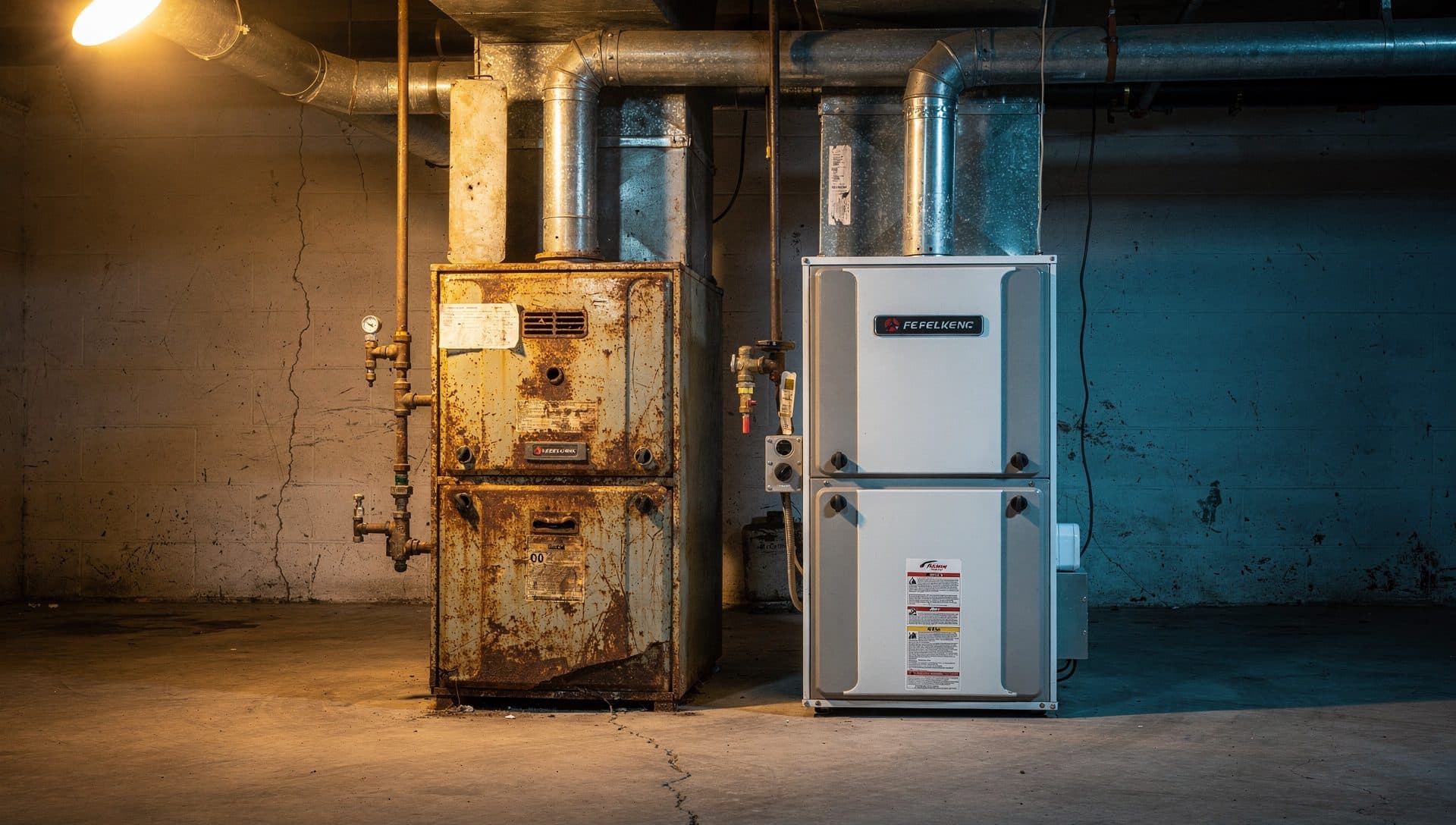
Cooling is refrigerant. Heating is combustion. Different world, same principle. Here is what a modern gas furnace does every single time you turn the heat on, in order.
- Your thermostat calls for heat and sends 24 volts to the control board.
- The board checks itself before it moves a single part. It confirms the limit switch is closed and the pressure switch is open. A pressure switch already closed at rest is a fault, and the board refuses to start.
- The inducer motor spins up and runs a pre purge, about 30 seconds, clearing the heat exchanger and flue of anything left over.
- The pressure switch closes, proving the inducer has established draft. If it does not close, the sequence stops right here. The igniter never lights and the gas valve never opens.
- The hot surface igniter energizes and warms up, about 19 seconds, until it is hot enough to light gas on contact.
- Only now does the gas valve open.
- The burners light and the flame sensor proves the flame within about 4 seconds. No proven flame and the gas valve shuts, then it retries. Three failed tries and the board locks out for an hour.
- The igniter shuts off once the flame is proven.
- The blower starts after a short delay and finally sends warm air into the house.
Nine steps, and the machine will not attempt step five until step four passes. So if something is jammed in your inducer, you do not get a flame problem or a blower problem or a gas valve problem. You get nothing. The furnace just sits there. Clear the inducer, and now it runs far enough to tell you whether anything else is wrong.
The safeties matter here too, and they are not the same thing. A high limit switch trips on too much heat, which almost always means airflow is restricted, a dirty filter or blocked returns, and it resets itself once things cool down. A flame rollout switch is different. It trips when flame comes out of the burner box where flame should never be, and it usually has to be reset by hand. That one is a symptom of something genuinely wrong, a blocked flue or a cracked heat exchanger. Resetting it and walking away is how people get hurt.
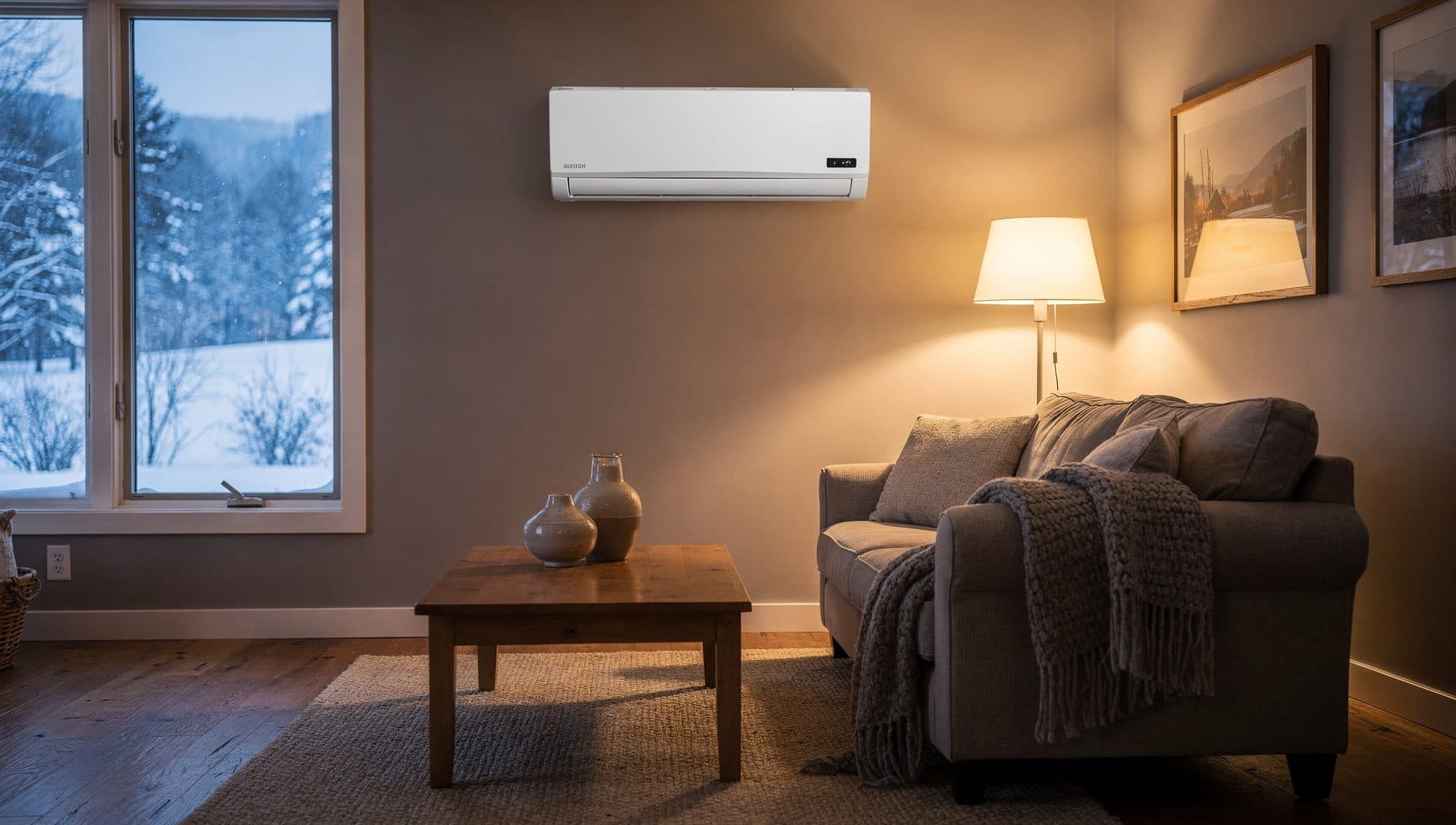
Heat pumps stack their own sequence on top of all of it, with a reversing valve that flips the refrigerant flow so the same equipment heats and cools, plus defrost cycles and backup heat staging. I specialize in forced air, and that is what I do all day, so I know these sequences cold.
What am I actually paying for in a diagnostic fee?
You are paying for someone who knows the sequence and walks it in order instead of guessing.
Around New England a diagnostic or service call fee generally runs between $95 and $195. What it buys you is a licensed person who can tell you which step failed and why, rather than someone swapping parts until the noise stops. And here is the counterintuitive part: the fee is the honest signal. ConsumerAffairs, in its May 2026 Boston HVAC guide, warns homeowners outright to be skeptical of any company advertising a $29 service call or a free tune up, because those offers are usually built to get a salesperson through your door, not to save you money.
Ask whether the fee is credited toward the repair if you approve the work. Plenty of good shops do that, and mine is one of them.
| Job | Typical range |
|---|---|
| Diagnostic or service call fee | $95 to $195 |
| AC capacitor replacement | $235 to $475 |
| Furnace igniter or flame sensor | $125 to $355 |
| Refrigerant leak repair and recharge | $425 to $1,250 |
Those are real published New England numbers, and they run above the national average, which is worth knowing before you weigh a quote here against something you read online. Now put my July call against that table. A capacitor, a leak repair, and a restriction are three separate line items out of three separate rows. That bill was not inflated. The machine genuinely had three things wrong with it.
Is my HVAC tech ripping me off?
Probably not, and the data backs that up. A 2025 survey of 1,000 homeowners run by FIELDBOSS with Pollfish found that 84 percent completely or mostly trust their HVAC technician to be honest and not oversell. That is a high number for any trade. The same survey found 21 percent were frustrated by costs coming in higher than expected.
Read those two together and you get the real problem. It is not that you think your tech is a crook. You trust him. The bill still surprised you, and nobody explained why. That gap is the entire reason I wrote this.
There is a real version of the bad outcome, and it deserves to be named honestly. It is rarely fraud. It is parts swapping. The Air Conditioning Contractors of America said it in its own trade press in February 2026: technicians replace parts until it starts, instead of identifying the root cause. That is what you are actually at risk of, and it costs you money, because every wrong part is a part you paid for.
The Bureau of Labor Statistics puts it plainer than I could. It says HVAC techs typically go through a lengthy period of on the job training to attain competency after they are hired. The license is the starting line. Knowing every step of every sequence, and knowing what to check when one of them fails, is the part that takes years. It is also the part that decides whether your bill is three real repairs or three guesses.
So here is how to tell the difference, and it costs you nothing to ask.
- Ask which step failed. Anyone who knows the sequence can tell you exactly where the system stopped and what proved or did not prove.
- Ask what he measured. Real numbers, a capacitor reading against its rating, a pressure, a temperature split, beat a hunch every time.
- Ask why this part and not the one next to it. A diagnosis has a reason behind it. A guess has a story.
- Ask what happens if it does not fix it. The answer tells you whether you are buying a diagnosis or a lottery ticket.
How I quote it
I walk the sequence in order, I tell you which step failed, and I show you the reading that proves it. If a repair uncovers something else, you hear it from me before I touch it, with the number attached, and you decide from there.
If I replace a part that turns out not to have been the problem, that one is on me, not on your bill. Diagnosing before I reach for a part is exactly how I keep it that way.
If your system is down, or it is running and something about it sounds wrong to you, call TJM Climate Control at 603-475-9027 and I will walk it in order. From Kingston out to Salem and Derry, and across the line into Methuen and Haverhill.